


How to Find The MLK Embrace Memorial on Boston Common
- Lori S.
- Jan 4
- 3 min read

Updated: Jan 18
In the heart of Boston Common—America’s oldest public park—stands one of Boston’s newest and most thought-provoking memorials: The Embrace. This powerful sculpture honors the legacy of Dr. Martin Luther King Jr. and Coretta Scott King, while also recognizing Boston’s deep connection to the civil rights movement.
More than a traditional statue, The Embrace invites reflection, conversation, and participation. It has quickly become a meaningful stop for locals and visitors exploring Boston’s historic and cultural landmarks.

A Monument With Deep Roots in Boston’s History
While Dr. King is most often associated with the civil rights movement in the South, Boston played a formative role in his life. Martin Luther King Jr. and Coretta Scott met in Boston in the early 1950s while attending graduate school—he at Boston University and she at the New England Conservatory of Music. These years shaped their personal relationship and the ideals that would later guide their work together.
The idea for a permanent memorial honoring Dr. King in Boston began in 2017, when the nonprofit organization Embrace Boston launched a national design competition.
The goal was to create a monument that reflected King’s legacy while also speaking to Boston’s role in civil rights history. More than 120 proposals were submitted before a final design was selected.

About the Sculpture: More Than a Statue
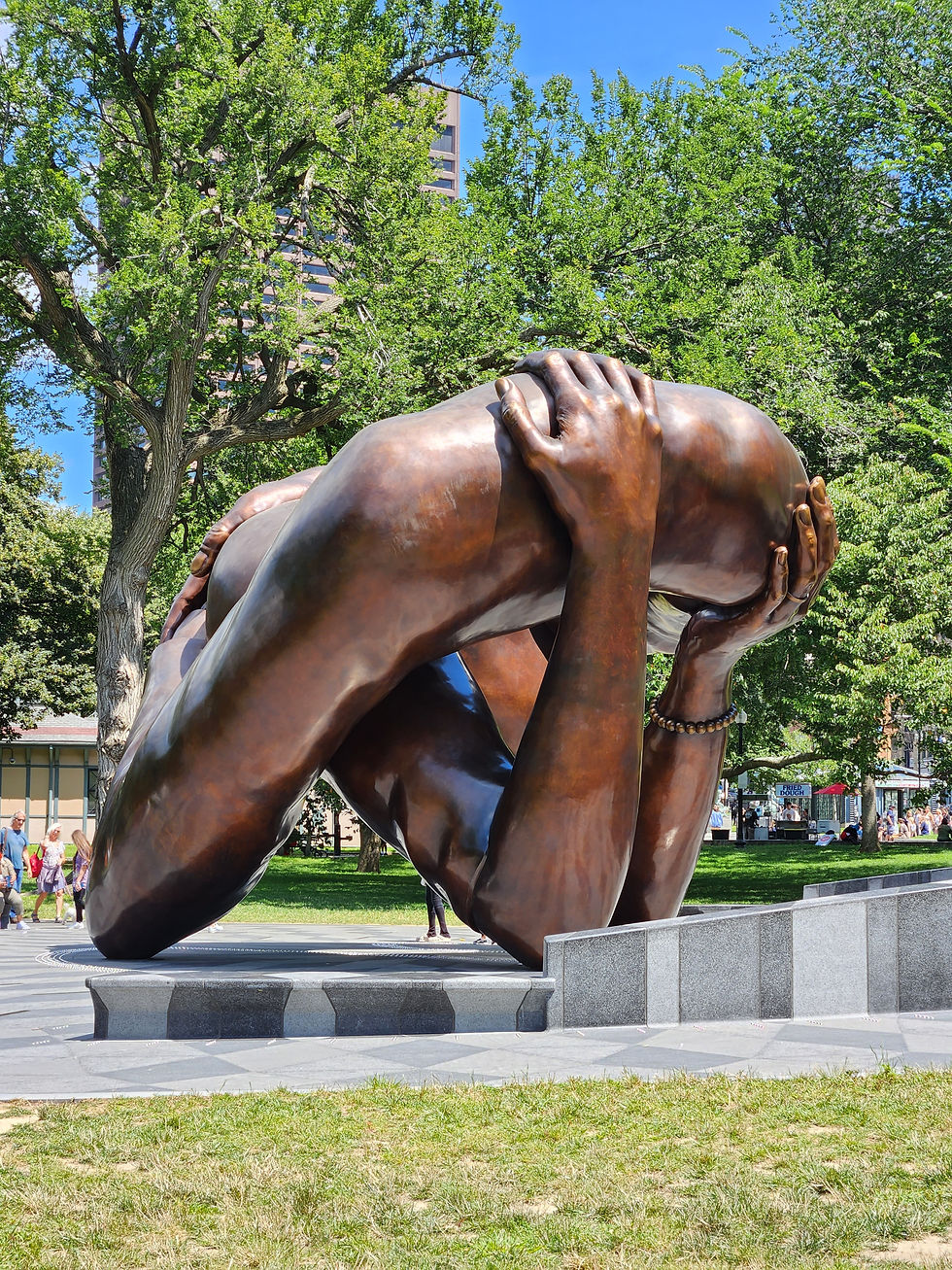
The winning design, The Embrace, was created by acclaimed artist Hank Willis Thomas. Rather than depicting recognizable facial features, the sculpture focuses on four interlocking arms forming a powerful embrace.
The design was inspired by a photograph taken in 1964, capturing Martin and Coretta Scott King hugging after he received the Nobel Peace Prize. By abstracting the figures, the artist shifts the focus away from individual likeness and toward universal themes—love, unity, support, and shared humanity.
Cast in bronze, the sculpture stands over 20 feet tall and weighs nearly 20 tons. Visitors can walk through and around it, experiencing the memorial not just visually, but physically. It’s meant to be entered, touched, and reflected upon.
1965 Freedom Plaza
Surrounding the sculpture is 1965 Freedom Plaza, named for the year Dr. King led a historic civil rights rally on Boston Common. The circular plaza includes engraved names and information recognizing local civil rights leaders and activists from Greater Boston who worked for racial justice during the mid-20th century.
This broader context reinforces the idea that The Embrace is not only about two individuals, but about a movement—and the many people who helped push it forward.
Public Reaction and Ongoing Conversation
Since its unveiling in January 2023, The Embrace has generated a wide range of reactions. Some visitors are immediately moved by its symbolism, while others are surprised by its abstract form. That range of responses is intentional.
The memorial was designed to spark conversation and invite interpretation. In that way, it reflects Dr. King’s legacy not as a static moment in history, but as an ongoing call to reflection, dialogue, and action.
Where to Find The Embrace in Boston
The Embrace is located within Boston Common, making it easy to include on a walking itinerary through downtown Boston. You’ll find it near the Boston Common Visitor Center and close to the Parkman Bandstand. It’s also just steps away from the Freedom Trail, making it a natural stop for first-time visitors exploring Boston on foot. Partner the visit to the Memorial with visiting Boston's Black Heritage Trail in nearby Beacon Hill.
There is no admission fee, and the memorial is accessible year-round.
Why The Embrace Matters
The Embrace represents a modern approach to public memorials. Instead of focusing solely on a historical figure, it centers on shared values—love, justice, and collective responsibility.
For visitors, it offers a quiet moment of reflection in one of Boston’s busiest public spaces. For the city, it serves as a reminder that Boston’s civil rights history is not just something to remember, but something to continue building upon.
Whether you stumble upon it during a walk through Boston Common or seek it out intentionally, The Embrace is a meaningful and memorable stop—one that encourages you to pause, reflect, and quite literally step into history.


